RadsolveSep 29, 2026
The $200,000 App Now Costs $50,000: What AI Did to Development Economics
In September 2026, a development studio with 500+ shipped products reported that AI-accelerated engineering has brought typical app costs from $200,000 down to around $50,000 — with timelines cut roughly in half. The savings are real. But 75% of an AI project's budget still goes to engineering, data, and security — not the model. Here's what actually got cheaper, what didn't, and how smart businesses are spending the difference.
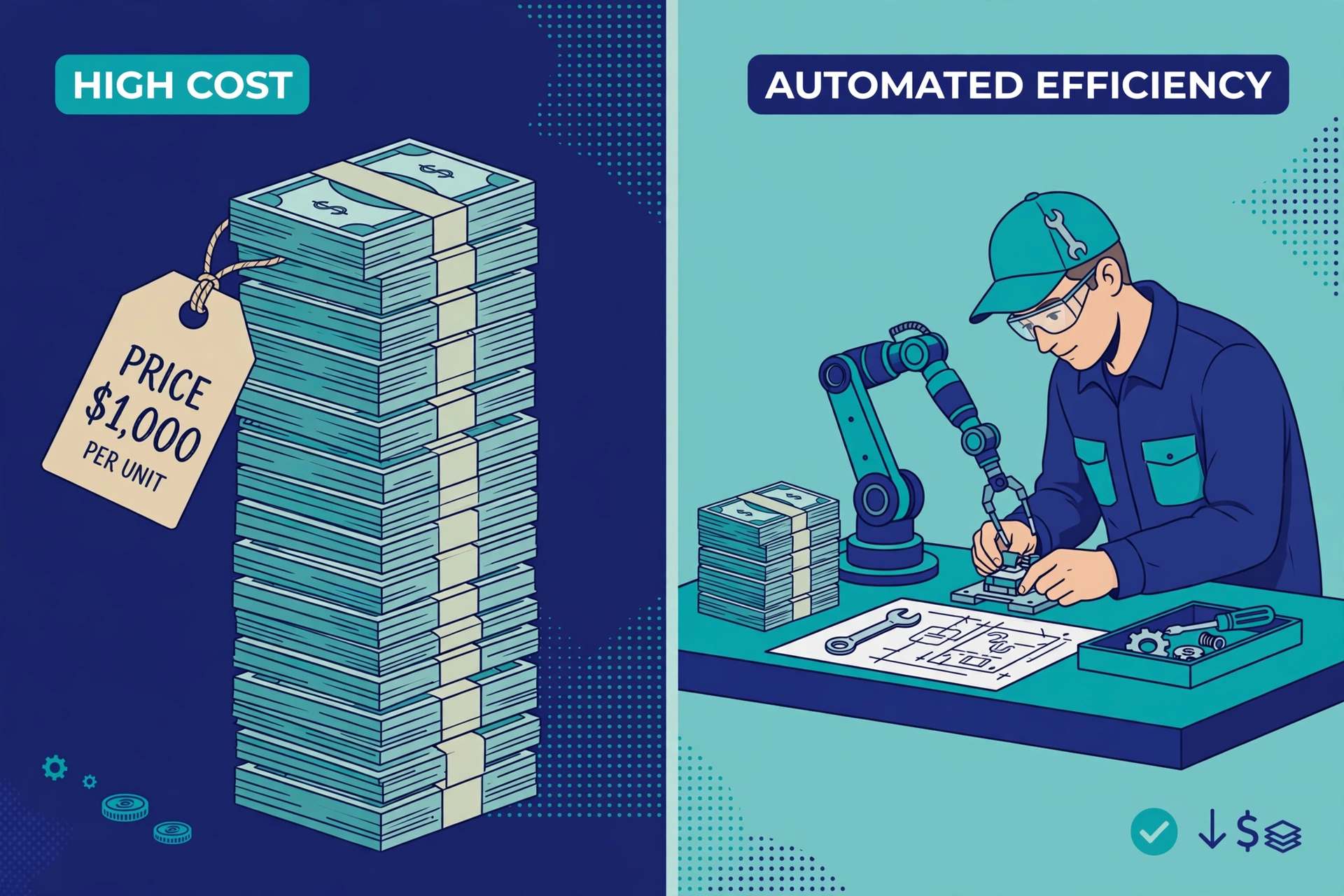
Every few years, software development gets a new price tag. This month, we got the clearest statement yet of the current one. Chop Dawg, a development studio founded in 2009 with more than 500 shipped products for clients including NASA, the NFL, and Hilton, announced in September 2026 that it is pairing AI-accelerated engineering with its planning discipline — bringing project costs that "once ran $200,000 down to closer to $50,000" and cutting timelines roughly in half.
If you're a business owner considering a custom app or AI feature, that's the headline. But the fine print is where the smart decisions live.
What the 2026 numbers actually look like
Industry cost breakdowns for 2026 put the landscape in bands. One widely-cited 2026 guide prices an entry-level AI tool or MVP at $15,000–$35,000, a production-grade business solution at $45,000–$120,000, and a complex enterprise AI platform at $150,000–$450,000+.
More interesting than the bands is where the money goes inside a project:
- Data engineering and pipelines: ~30% — cleaning schemas, structuring ingestion, building embeddings
- AI architecture, RAG, and model integration: ~25%
- Backend logic, APIs, and UI: ~20%
- Testing, validation, and security: ~15%
- DevOps, infrastructure, and deployment: ~10%
Read that twice. Roughly 75% of the budget goes to standard software engineering, data plumbing, and security — the model integration itself is one component of a much bigger system. AI made the code cheaper to write. It did not make the data cleaner, the requirements clearer, or the security posture stronger.
What got cheaper — and what stubbornly didn't
Got cheaper: boilerplate and scaffolding. CRUD endpoints, admin panels, form validation, test harnesses, migration scripts — the commodity code that used to eat weeks now takes days. Prototyping is dramatically faster, which means you can validate an idea with real users before committing real budget.
Didn't get cheaper: everything that determines whether the thing works in production. Data quality. Evaluation — knowing whether the AI is actually right, on your data. Security review. Integration with the systems you already run. The ongoing cost of running the models month after month.
This is also where the market's warning label sits. The same September announcement flagged "the flood of low-quality, AI-generated apps" that app stores frequently reject — vibe-coded products that look finished in a demo and collapse under real users, real data, and real edge cases. The cheapest way to build software in 2026 is still the most expensive way to rebuild it in 2027.
How smart businesses are spending the difference
1. Buying scope, not discounts. If your budget was $100,000 in 2024, don't build the 2024 app for $40,000 and pocket the rest. Build the app you actually wanted — the integrations, the admin tooling, the analytics layer that got cut from the original spec.
2. Spending the savings on the unglamorous 75%. Data pipelines, evaluation harnesses, security review, monitoring. This is the work that separates a demo from a product, and it's exactly the work that AI doesn't do for you.
3. Planning for the second year. Model APIs, infrastructure, and maintenance run 10–20% of build cost annually, and AI features need ongoing evaluation as models and data drift. Budget the runway, not just the launch.
The agency question, reframed
A year ago, businesses asked agencies "can you build with AI?" Now the sharper question is "what does your process do with the time AI saves?" The answer you want to hear is the unsexy one: more planning, more testing, more evaluation, tighter security — the discipline that turns cheaper code into a product that survives contact with customers. Speed without discipline is just a faster way to ship technical debt.
The $200,000 app really does cost $50,000 now. The trick is making sure the $50,000 app is worth more than the demo.
Originally published on Radsolve by Tim Velzy.